Let Learning Take Its Shape: Making Space for Meaningful Change
Grounding
Lately, I've been learning how much reciprocal relationships ask of me; how conflict, when it's held with care, doesn't damage a friendship so much as deepen it. There's a particular awkwardness I feel in my body before I bring up something hard with a friend: a tightening, an urge to soften what I mean or avoid saying it at all. But almost every time, on the other side of that discomfort, is relief, the relief of living in integrity with my values, of trusting the friendship enough to tell the truth. The conversations I almost didn't have are often the ones that end up deepening the relationship the most.
Sometimes those conversations end differently, they surface the end of a friendship, or a real difference in alignment. That's valuable information too. As I am ever evolving, it tells me if I'm in relationship with people who are aligned with me in whatever season I’m in. Organizations need that same capacity: to learn what should remain and what needs to be released, so their energy and labor stay strategic and values-centered.
Naming my own strengths has helped me understand how I best take things in and communicate what I find; a discovery that's shaped my personal life just as much as it's shaped my evaluation practice.
I've always been curious, wanting to know why, how, when. Being curious has also oriented me to be an active listener, wanting to understand what values, needs and hopes anchor the choices people make.
Long before I had language for evaluation, that curiosity was already a habit; a pull toward what's actually happening here, what am I not seeing yet. Reflective inquiry has been one of my core tools for as long as I can remember, not just professionally, but as a way of moving through the world and being present with people.
It makes sense, in hindsight, that this is the work I landed in. My top five StrengthsFinder themes are Arranger, Connectedness, Input, Positivity, and Woo, and together they shape how I relate to data and to organizations. Input keeps me gathering, staying curious, collecting pieces before I know what they're for. Arranger takes what I've gathered and organizes it into something coherent and usable. Connectedness reminds me that none of what I'm arranging exists in isolation; every piece of data is connected to a person, a relationship, a larger system. Woo and Positivity shape how I show up while I do this work: genuinely energized by new people and new organizations, and oriented toward what's possible rather than only what's broken.
Together, these mean I don't experience data as numbers to report. I experience it as pieces of a story that's still being told; connected to real people and relationships; waiting to be arranged into something an organization can actually act on, and approached with genuine curiosity about what we might find.
This is why organizational learning matters so much to me. It is more than a value, it is a posture I try to bring everywhere, in my friendships and in my work alike.
The Posture of a Learner
Holding Expertise Loosely
Most organizations know how to talk about learning. Fewer know how to practice it.
That gap matters, because organizational learning isn't just a value you hold; it's a posture you take. And the posture Culturally Responsive and Equitable Evaluation (CREE) asks organizations to take is a hard one: to be a learner, not an expert.
This is a real ask. Many organizations, especially ones doing good, hard work, have built their sense of legitimacy on expertise. They know their field. They know their history. They know what they've built and what it took to build it. Being qualified, in this frame, means knowing things.
CREE asks something different. It asks organizations to be qualified not by what they know, but by how well they listen, especially to the community members who are the real experts, in their own experience. Responsiveness becomes the measure. Not “how much do we know,” but “how well do we hear, and how much does what we hear change what we do.”
This is where organizational learning stops being abstract and becomes a practice; something an organization does, repeatedly, on purpose. It shows up in the data an organization chooses to gather, who's in the room when that data gets interpreted, and whether community input actually redirects decisions or just gets acknowledged and filed away.
It's also, I'll be honest, disorienting. Positioning yourself as a learner instead of an expert can feel like giving something up; especially for organizations that have fought hard to be seen as credible, capable, knowledgeable. But there's a liberation in it too: you're no longer responsible for having all the answers. You're responsible for staying in relationship with the people who do.
Think about what it takes to have a hard conversation with a close friend, like the one I named at the start of this letter. Naming something that isn't working between you, even though it's uncomfortable, because you're committed to the relationship. You don't bring it up to punish them. You bring it up because you love them enough to want the friendship to keep growing, and because you've learned that reciprocity and honesty is what makes a friendship trustworthy in the first place. Organizational learning asks something similar: naming what isn't working, sitting in the discomfort of that honesty, not to find fault but because you're committed to the relationship, with your community, your team, your mission. Learning how to love one another well is a good model for what it means to hold learning as both a posture and a practice. It isn't a one-time confession. It's something you return to, again and again, for as long as the relationship matters to you.
But listening isn't enough on its own. Learning as a practice requires a commitment to adapting, iterating, and experimenting; to actually testing what lands and adjusting when it doesn't. This is where evaluation earns its place: not as a report card, but as a feedback loop. Done well, evaluation creates real-time understanding of what matters, to whom, and why; and it gives organizations a structure for acting on what they learn, instead of just collecting it.
This is the piece that's easy to skip. An organization can commit to listening in the abstract and still never build the loop that makes listening matter; never circle back, never adjust, never let community input actually redirect a decision. And without that loop, trust doesn't build. You can't meet your goals; supporting thriving, addressing barriers; if you're not structured to learn what those goals should even be, for the people you're meant to serve.
So organizational learning isn't just posture. It's infrastructure. It's the difference between an organization that says it wants to learn, and one that has actually built the muscle to.
AAW's Organizational Learning Cycle
If you're looking for a place to start, this is a simple four-part cycle I return to often in my own practice:
Listen — gather input through real relationships, not just forms; notice what's working, not only what isn't.
Reflect — before rushing to conclusions, create space, individually and collectively, to actually sit with what you've heard. This is where rest and somatic awareness matter; a depleted team can't reflect well.
Decide — let what you've learned actually shape a decision, however small. If you choose not to act on something you heard, name that tradeoff honestly rather than letting it quietly disappear.
Act & Adapt — implement the change, then return to listening. The whole thing is a loop, not a line. It doesn't end once a decision is made.
This is my own synthesis, built from what I've seen work in CREE-aligned practice. If you want to go deeper, several established frameworks cover similar ground and are worth exploring on their own:
Kolb's Experiential Learning Cycle — David Kolb's 1984 model of learning as a process where knowledge is created through the transformation of experience, moving through concrete experience, reflective observation, abstract conceptualization, and active experimentation.
Appreciative Inquiry (the 4-D Cycle) — developed by David Cooperrider and Suresh Srivastva, a strengths-based approach that shifts organizational development from a deficit focus toward what's already working and what an organization desires to become.
Developmental Evaluation — associated with Michael Quinn Patton, a system of tools and guiding principles built on continuous inquiry, reflection, and application of knowledge, designed to support organizational learning in emergent, complex programs.
Plan-Do-Study-Act (PDSA) — a quality-improvement cycle rooted in Deming's work, built around small, testable changes: plan a change, try it, study what happened, act on what you learned.
Whatever you choose, the goal is to make sure you are making room to learn and act on what you learn.
Trusting the People, Trusting the Process
Organizational learning like this isn't just about posture; it also asks organizations to trust something adrienne maree brown names as core to how change actually happens. In her framework of emergent strategy, brown offers a set of principles for how transformation moves through systems, drawn from nature, science fiction, and decades of movement work. Among them: trust the people; if you trust the people, they become trustworthy; and move at the speed of trust.
“Moving at the speed of trust is conflated with gaining consensus. It is not the same thing. Slowing down in order to get multiple perspectives does not mean that you're desiring to have everyone agree before moving forward.” — Afrita Davis
These aren't abstract ideas. They're a direct challenge to how most organizations relate to the people they serve, and to their own data. Trusting the people means trusting community members as the experts in their own experience, the same commitment CREE asks of organizations. Moving at the speed of trust means resisting the urge to rush learning for the sake of a deadline or a funder's timeline, and instead letting relationship-building set the pace.
Moving at the speed of trust also requires something organizations rarely name out loud: rest. Tricia Hersey's work on rest as resistance reminds us that a depleted organization; like a depleted person; can't actually listen well. As she writes in Rest Is Resistance, “our exhaustion will not lead us to liberation.” An exhausted mind has little room left for curiosity; it's hard to listen well, or truly care, when you're just trying to get through the day. Exhaustion narrows attention down to what's urgent, and urgency is rarely where the deepest learning lives. An organization that never rests can gather data endlessly and still fail to learn, because learning requires the capacity to sit with what you've heard, not just collect it.
brown also reminds us that what you pay attention to grows; which is where an asset-based frame comes in. An organization that only pays attention to what's broken will keep finding what's broken. An organization that pays attention to what's already working; what community already knows, what's already strong; grows more of that. This is the heart of an asset-based approach to organizational learning: not ignoring the barriers, but refusing to let deficit be the only lens.
And brown offers one more principle that feels made for evaluation work specifically: never a failure, always a lesson. When organizational learning is built on curiosity instead of self-protection, “did it work” stops being the only question. The better question becomes: what did we learn, and what does it ask us to do differently now?

Unlearning as Practice
Here's the part that's easy to underestimate: adopting this posture isn't a one-time decision. It's a practice; real, sustained, sometimes uncomfortable practice; because equity work asks organizations to unlearn patterns most of us were never taught to see in the first place.
Tema Okun's work on white supremacy culture names this directly; patterns used as norms and standards without ever being proactively named or chosen by the group, showing up in the attitudes and behaviors of everyone, regardless of who leads the organization. Issue 1 already named urgency as one of these patterns. Three more are worth sitting with here: perfectionism, progress is bigger, and power hoarding.
Okun says that “White supremacy culture uses perfectionism to preserve power and the status quo.” This can look like treating every misstep as failure and centering the polished final outcome over the actual experience of getting there. It shows up in evaluation as the long, buttoned-up end-of-project report; the thing that has to be right, because there's no room for it to be a work in progress. Evaluator Lauren Beriont, writing with her firm Emergence Collective for the American Evaluation Association's AEA365 blog, offers a different standard: high quality instead of perfectionism. In practice, that looks like regular, honest check-ins instead of one high-stakes final report, and mistakes reframed as material for learning instead of evidence of failure.
Okun asserts that progress is bigger, more is the quiet belief that growth only counts if it's bigger, faster, more. An organization can hit every growth metric and still fail the people it serves, if we don’t examine the quality of their experience. Beriont's alternative is progress that's more just and increases wellbeing: success measured by whether people are actually better off, not just whether the numbers went up.
And then there's power hoarding, which makes it hard to let community input actually redirect a decision at all; arguably the pattern with the highest stakes, because it's the one that determines whether anything else on this list gets to change.
Power hoarding is where this gets concrete. Nearly a century ago, management theorist Mary Parker Follett distinguished power over; a relationship built on dominance and coercion; from power with; a shared, coactive power built through collaboration. Shifting from power over to power with is an equity principle as much as a management one: it's what “trusting the people” actually looks like once it leaves the realm of a values statement. An organization can say it values community voice, but if its decision-making structure still runs on power over, that value has nowhere to land.
“The structures that we create are things. They are objects. They are not people… They are not who we are. They are the things that we do.” — Afrita Davis
Unlearning these patterns takes real infrastructure; intention, practice, accountability, time; which is why organizations must get comfortable with an ongoing posture of learning, not a destination to arrive at once.
Leadership Needs Its Own Practice
Trust, rest, and attention aren't just organizational principles, though. They deepen, or get stunted, by leadership. This is where power dynamics complicate things. A leader's discomfort with challenging feedback can hide behind the language of decision-making; “we considered that and moved differently” can be an honest tradeoff, or a way to avoid naming that the feedback stung. That same tightening I feel in my own body before a hard conversation with a friend shows up in leaders too, it's just easier to hide behind a title. Community and staff usually sense the difference, even unspoken. This is why leadership, board and executive alike, need training in receiving feedback, not just gathering it: learning to experience honest sharing as a gift, not a threat.
Because when a leader can't tell the difference between “I heard this and chose differently for good reason” and “I heard this and it was too uncomfortable to sit with,” trust erodes, even if no one names why. Community members and staff often sense the difference long before it's ever spoken aloud. Learning to see honest, sometimes hard feedback as a gift rather than a threat isn't a soft skill; it's the skill that determines whether an organization's stated commitment to learning is real.
Investing in the Leader, Not Just the System
Organizations often invest real resources into learning at the systems level: better data collection, evaluation processes, feedback mechanisms, community engagement infrastructure. This is good and necessary work. But organizational learning can't happen in an organization alone; it has to happen in the people leading it, too. A system can gather all the right feedback, ask all the right questions, build the most thoughtful process imaginable, and still fail to create change if the leader receiving that feedback hasn't developed the capacity to actually hold it.
This is the gap that's easy to miss, because it's not visible in a strategic plan or an evaluation report. A leader is the place where organizational learning either becomes real or quietly stalls. You can build the most thoughtful feedback loop in the world, but if the person receiving that feedback hasn't done the internal work; separating their own defensiveness from the substance of what's being said, staying present instead of moving into self-protection, tolerating the discomfort of being seen as imperfect; the loop closes without ever completing. The system did its job. The leader couldn't receive it.
This is why leadership development can't be treated as an afterthought, something squeezed in once the “real” organizational learning work is finished, or a perk reserved for leaders who've already proven themselves. It has to happen alongside the systems work, not after it. Organizations don't just need to learn. Their leaders need support learning how to learn; how to hold feedback without collapsing into either defensiveness or self-abandonment, how to lead through discomfort instead of around it, how to model for their own staff and boards what it looks like to receive something hard and stay in relationship anyway.
This is also, I think, where evaluation and coaching are natural partners rather than separate disciplines. Evaluation can build the feedback loop. But coaching builds the capacity to actually walk through it. Without that second piece, even the best-designed learning system will eventually run into a leader who can't receive what it surfaces; and the work stalls there, quietly, often without anyone naming why.
“What message does it send when you set high expectations and standards for all your staff to follow, and your leaders refuse to follow it? You will never advance the organization. You cannot get in a place of trust.” — Afrita Davis
This is where I want to bring in Afrita Davis, MA, CPCC, ACC, a Values based leadership coach and Organizational Culture Guide at Model Integrity LLC with 8+ years of nonprofit leadership experience.
Featured Voice: Afrita Davis
I asked Afrita about rest, leadership, and what it means to hold knowledge without hoarding it. A few things she said have stayed with me since:
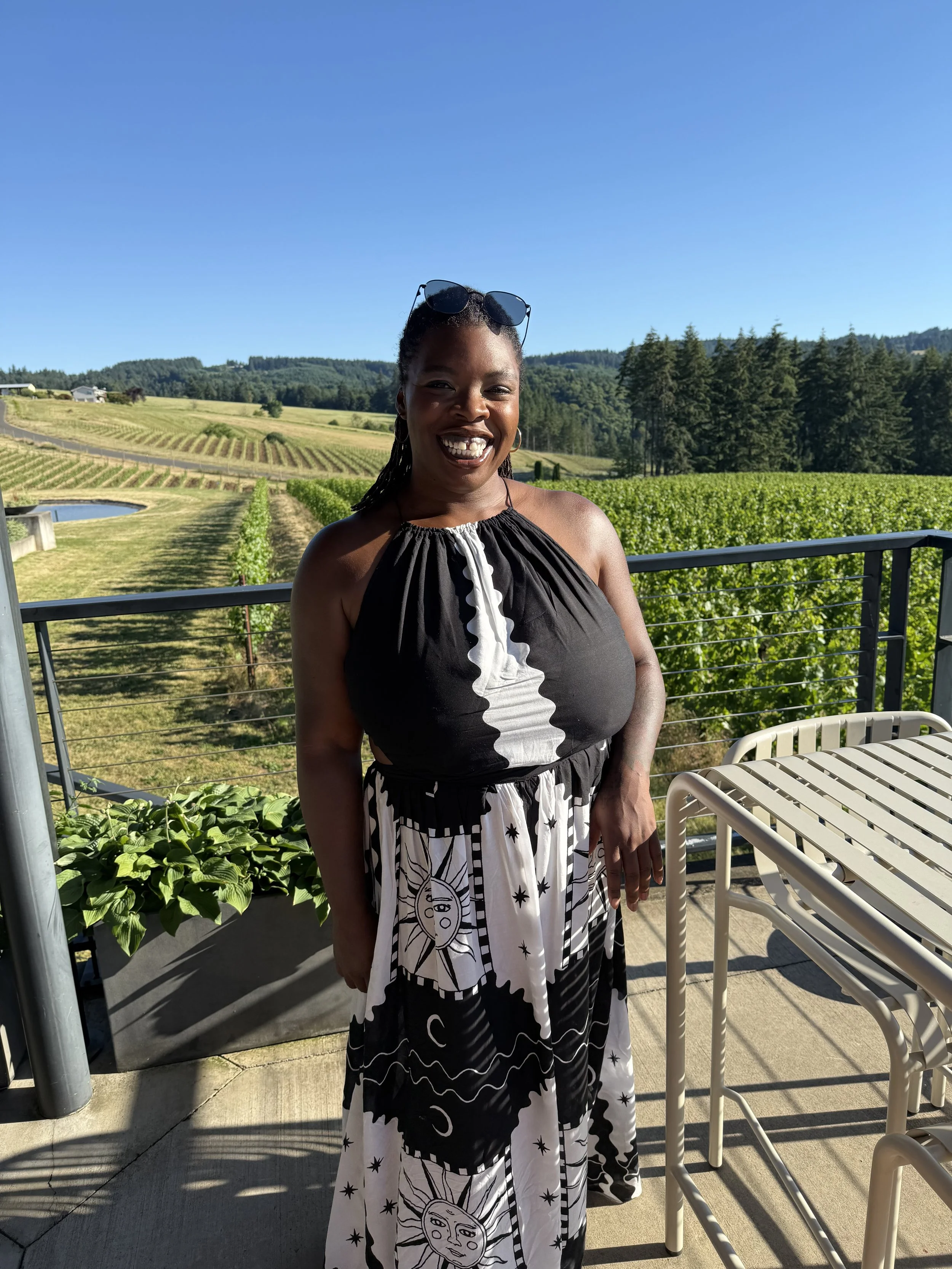
“I haven't witnessed a lot of organizations where leaders have the space to be well-rested, but do not believe, in order to be seen as a valuable leader, that rest is something that they can do.” — Afrita Davis
“This knowledge does not belong to an individual.” — Afrita Davis
“The moment you posture yourself as being ‘the one,’ you have now done a disservice to every other person who has served you and supported you.” — Afrita Davis
Want the full conversation? Watch the interview on YouTube: https://youtu.be/FJs4R4vKrLQ
Afrita is currently taking on one or two new clients who are ready to learn more about themselves and their organization's culture. If that's you, reach out by email: afrita@modelintegrityllc.com or connect with her on LinkedIn.
Afrita Davis, MA, CPCC, ACC is a Values based leadership coach and Organizational Culture Guide at Model Integrity LLC, with 8+ years of nonprofit leadership experience and training through the Co-Active Training Institute.
Closing: An Invitation, Not an Obligation
Organizational learning, at its best, isn't a mandate handed down from a funder, board, or executive checklist waiting to be satisfied. It's an invitation; one your organization gets to accept, again and again, in how deeply you engage with your mission and the communities you serve.
And it's a gift, too. Every piece of feedback, every moment of community input, every hard conversation about what isn't working; these are gifts your community is offering you, evidence that they trust you enough to be honest. Receiving that well, and letting it actually shape you, is one of the most values-aligned things an organization can do.
This is where learning holds two things at once. It lets us be less harsh with ourselves when we make a mistake or don't yet know something, because not-knowing is part of what it means to still be learning. But it doesn't let us off the hook. The same posture that softens our self-judgment also sharpens our awareness of the weight our choices carry, because we're actively listening, responding, and adapting instead of standing still. So while learning is a gift it is also a commitment.
If this issue has you wondering where to start, revisit the cycle above; listen, reflect, decide, act and adapt. You don't need to build the whole thing at once. Pick one component and start there, at whatever pace fits your organization.
The fear of the unknown, what we don’t know and must make room to learn, is valid. This type of transparency asks an organization to be willing to be seen clearly, unfinished parts included. I still feel that tightening in my body sometimes, even now, before a conversation I know needs to happen. But organizations, like friendships, that move through that fear often come out more informed, more aligned with their community's actual experience. That alignment doesn't just feel good; it strengthens the organization itself. It makes your story of impact more credible, because it's no longer a story you're telling about your community. It's one you're telling with them. If it helps, think of it the way you might think of a friendship worth keeping: the truth, held with care, is usually what makes it last.
Reflection Questions
Where in your organization is learning treated as posture, but not yet built into practice; where does listening happen, but doesn't actually redirect decisions?
What is your organization already good at that you haven't named out loud? What might grow if you paid more attention to it?
Is your organization moving at the speed of trust, or the speed of urgency? What would it look like to slow down enough to actually learn?
What are you tending right now; in your own knowledge, your team's, your community's; that someone else will eventually inherit?
If organizational learning were treated as a gift rather than an obligation, what would you want to receive first?