A Letter to the Organizations We Love: We Are Mission-Aligned, Not Limitless
I grew up believing that if you cared about your community, you weren't supposed to care about money; that asking to be paid a living wage was the first step toward greed, almost a betrayal of the mission. So when I started working in nonprofits, I came in earnest. I wanted to support my community and show up fully for the work.
What I couldn't yet see were the systems already at work around me: institutionalized racism that treats Black women's labor as owed, and the Strong Black Woman archetype that recasts endless self-sacrifice as strength. As Tricia Hersey writes in Rest Is Resistance, "Grind culture is a collaboration between white supremacy and capitalism. It views our divine bodies as machines." And you can't resist a system you aren't aware of, especially when your intentions are so different from what it was built to do. So I walked into organizations ready to pour out my whole earnest self. The trouble is, many organizations within the nonprofit industrial complex, a term popularized by INCITE! Women of Color Against Violence, describes the system that ties nonprofits' survival to the priorities of funders and the state, and was designed to extract that passion and labor without considering what reciprocity and real resourcing actually require.
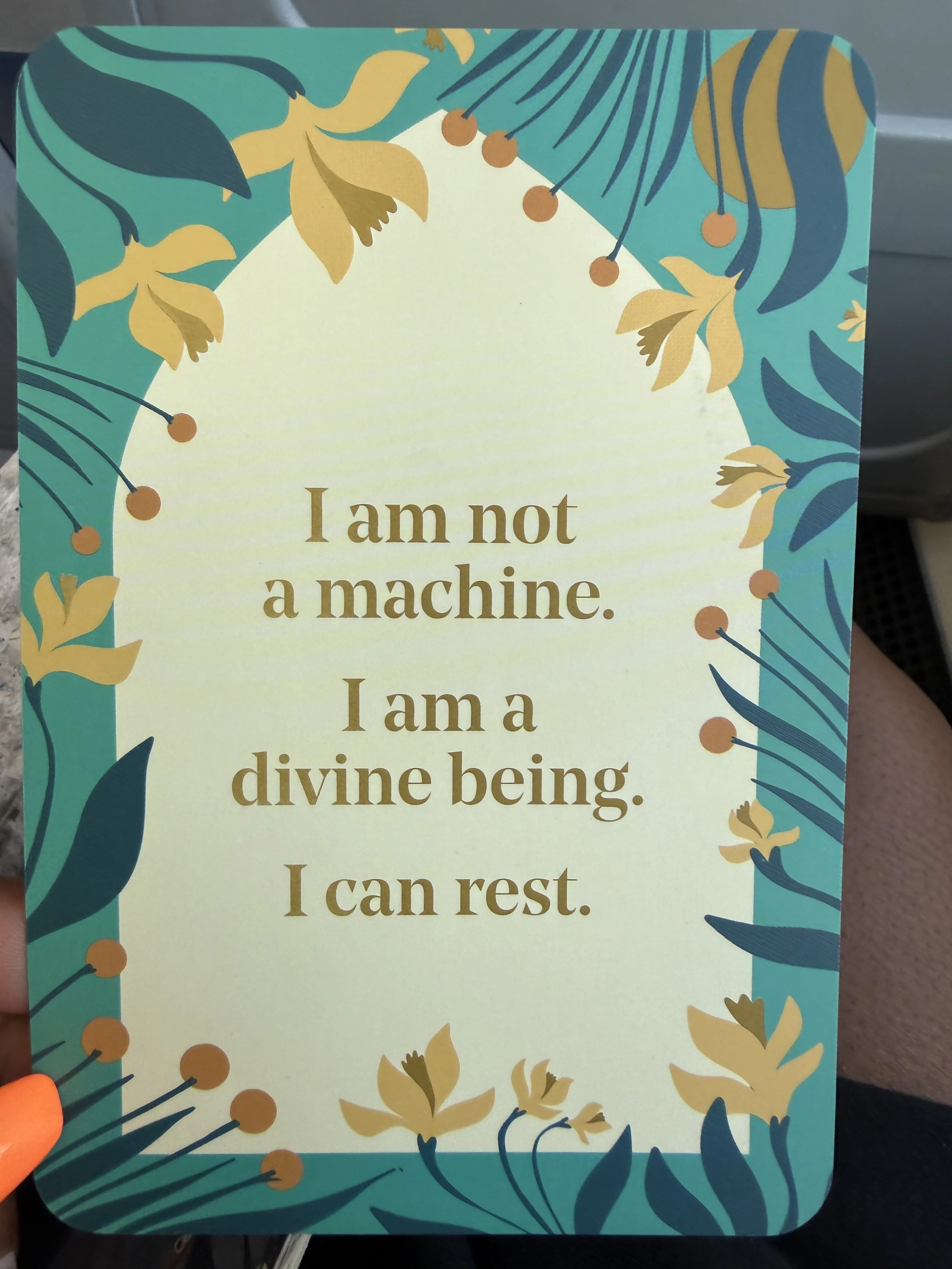
Tricia Hersey Rest Deck
Working inside those conditions without seeing the systems behind them wore me down over time. When organizations fail to provide real resources and reciprocity, they don't just burn out one person, they set up the people who come after to carry the same burden. The sector knows this is a crisis: in the Center for Effective Philanthropy's State of Nonprofits 2024: What Funders Need to Know report, 95% of nonprofit leaders said they were concerned about staff burnout. I know that concern from the inside. I could name the systems causing harm out in the world. But inside an organization whose mission matched my values, where the work mattered deeply to me, the strain didn't look like a problem with the system. It looked like the cost of doing justice work. The long hours, the stretched capacity, the giving past my limits all felt like part of the commitment, not signs that the conditions needed to change. And all the while, I watched brilliant leaders walk out of spaces they loved, or quietly stop trusting the environments they were in, because those conditions were never designed to sustain them.
That is where the work of change belongs. Honoring the leaders you bring in means building conditions that don't quietly run on their self-sacrifice.
Why Individual Practice Isn't Enough
I share my story of burnout not because it's unusual, but because it isn't.
In work that serves the community, the needs are often urgent and immediate, and caring for staff can slip down the list. When attention does turn to staff, it tends to focus on what leaders can do differently: set better boundaries, advocate more clearly, protect their own capacity. All of that has value. But it also quietly puts the weight of change back on the people already carrying too much of it. A leader can do all of this well: name their limits, ask for what they need, learn their own body's cues, and still burn out, because none of that changes the infrastructure they're operating inside. If the system doesn't change, individual practice becomes damage control, not prevention. As Dr. Tanisha Tate Woodson put it when we spoke for this issue, “systems are resilient.” In other words, they tend to absorb pressure for change without actually transforming.
That is why this letter is addressed to organizations; the executives who shape policy, the managers who shape daily conditions, the boards who shape what gets resourced, and anyone within an institution who has a hand in building the systems leaders operate inside. Not because leaders don't have their own work to do. I believe deeply that we do, and Issue 3B speaks to this. But because holding institutions accountable for what they ask of the leaders of color they depend on is different work than asking those leaders to be more resilient, more boundaried, more "enough" inside conditions that were never designed with them in mind. This isn't about blame. It's a call in, an invitation to reflect and change rather than a call out, in the spirit of Loretta J. Ross's Calling In framework, which builds on a term from Ngọc Loan Trần. And it's about responsibility: the kind that belongs structurally to organizations, not personally to the people their structures depend on.
Why I Write This From Love
Before I go further, I want to share where my relationship with these organizations began, and why this is a loving critique and a call in. I was a nonprofit kid. I came up in the Bay Area, in Oakland specifically, first as a participant in youth and young adult programs, later as staff in community organizations. They resourced me and made room for me to trust my own abilities, and I brought my passion, my community, and my work into them. My heart for this work, and the leaders I modeled myself after, came from community. School and theory later gave me a systems lens and the structure to name what I was seeing, but they couldn't build heart. That grew in relationship with those organizations, in places where what I cared about could become something I knew how to practice.
Oakland taught me that when you love a community, you love its strengths and you hate what makes it suffer. That love makes you committed. It teaches you to build from what's already there instead of what's missing. I watched leaders, organizations, and neighbors get it out the mud, turning lemons into lemonade again and again. That's the energy this work was born from for me.
This is why I believe that when you love something, you critique it. Not despite the love, but because of it. You don't spend this kind of energy on something you're indifferent to. I've now experienced nonprofits as a participant, as staff, and as an evaluator helping organizations tell the story of their impact, so I know what they can be. I've watched organizations do this well, and I've watched organizations struggle, with leaders doing the best they can with what they have. But more often, I've seen leaders pushing through, treating these conditions as just part of justice work, the same way I once did. As Hersey puts it, "We are socialized into systems that cause us to conform and believe our worth is connected to how much we can produce." Every now and then, I come across an organization that doesn't put the onus on leaders to build that capacity alone, one that holds it as the system should. Those organizations show me what's possible. I am writing to organizations because I'm invested in their sustainability and their thriving, and because I've lived what they made possible for me. This letter is an act of that investment.
I also want to name something that gets lost too often in these conversations: the leaders of color walking into your organizations are not showing up to serve some distant community they've never known. So often, we are showing up to serve our own communities; the neighborhoods we grew up in, the people who raised us, the systems that shaped our own families. And while systems and outsiders often look at our communities through a lens of deficit, we see the strengths, the gifts, and the potential within them: what scholar Tara J. Yosso calls community cultural wealth. Not charity. A commitment and love for our community. That distinction matters, because it changes what your organization is actually receiving when a leader of color joins your team. You are not simply hiring a resume. You are gaining someone's lived experience and their commitment to the community you're serving. That deserves to be resourced with responsibility and stewarded with care, not assumed. Organizations that understand this take good care of the leaders carrying it. Organizations that don't quietly spend down a kind of trust they can't easily rebuild once it's gone.
I think of my dad when I say this. He's a pastor whose ministry lives in the community, in the streets and at a local park, in West Oakland. He has also taken on roles inside organizations doing this work, from transitional housing to supporting young people and adults navigating the justice system. I've watched him lead within organizations, and I've watched him build his own. What has stayed true across all of it is his consistency: to his why, and to engaging people from a deeply human, strength-based place. He has built his own systems to keep that commitment sustainable, whether he's inside an institution or outside of one. And when he has worked inside organizations, they've been better for it. He deepened their work and their reach. Watching him has inspired so much of how I show up in this work, and it raises a question I think every organization should be asking: what can we learn from leaders like him about setting them up for success, so they choose to stay? What I've learned is simple: when someone is that passionate and that committed to the work, you resource them. You support them. You don't hand them more labor and more barriers and call it an honor.
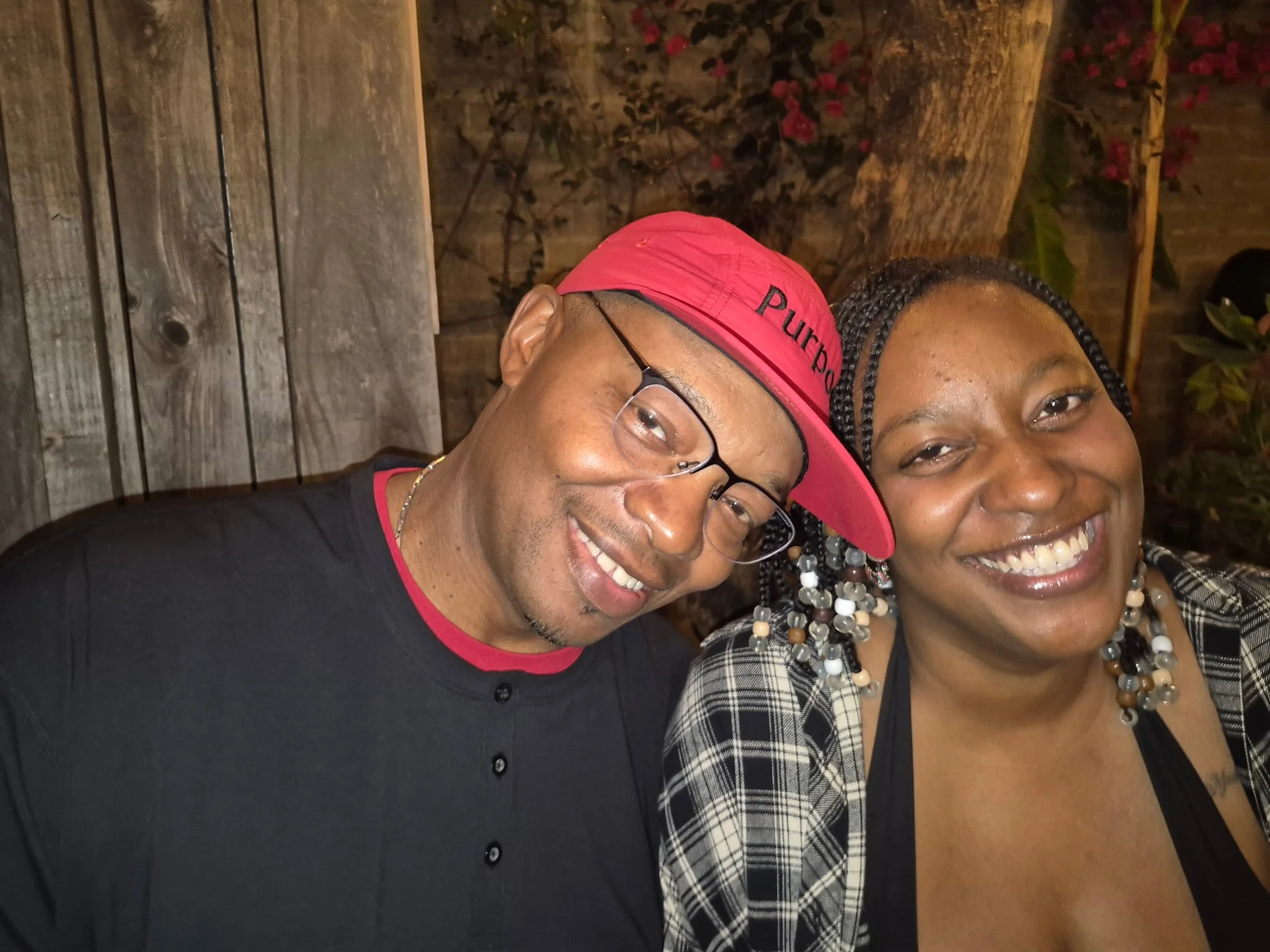
My dad and I
As a consultant, I've seen this gap from the other side too: genuinely passionate leaders whose own organizations, while well-meaning, were quietly a barrier to them deepening their work and having the capacity it required. Sometimes it looks like workloads so heavy that leaders are too exhausted to be creative. Sometimes it's never having the time, budget, or support to dream, imagine, and do the work well. So much of my consulting practice is built around this: building plans that honor a leader's actual capacity and make the case for the resources an organization needs to put behind it, so the commitment I'm describing doesn't stay a feeling. It becomes something resourced.
What My Body Was Trying to Tell Me
Even inside systems not built for my success, my body was keeping score. I didn't learn about boundaries in a workshop. I learned them through what it cost me to go without them. It started speaking up before I was ready to listen. It showed up as anxiety, and then in my gut. I'm naming this because these costs are real. Pushing past our limits leaves its mark on our bodies and nervous systems. And from a Black liberation lens, I've come to see that a Black leader making herself sick for the work is practicing an incomplete version of liberation, one that invests in freeing the community we serve while leaving our own freedom out.
Individual choices alone weren't enough to change that, not with institutional racism and systemic strain pressing in. I needed a different framework and a community to practice it with. I had the privilege of learning from Resmaa Menakem, whose somatic abolitionism he describes as a living, embodied anti-racist practice, rooted in the old wisdom of bodies respecting, honoring, and resonating with other bodies. It shifted how I understood justice work itself. It gave me language, practice, and people to learn alongside as I built boundaries. For the past three years, I've met monthly with my somatic triad, two other Black folks and me, to get our reps in: staying in our bodies, noticing what we experience, and practicing this reframing together. Somatic abolitionism also taught me to notice my body's yes, its excitement, its expansion, the moments when the work truly fed me. And it showed me that honoring my own capacity and transforming the systems that strain it aren't separate tasks. They're the same work. The urgency so many organizations run on isn't neutral. It keeps us out of our bodies, and staying embodied, slow enough to feel what's true, is itself a form of resistance.
I want organizations to sit with the reality that human capacity is finite, but it is not fixed, and it is not weakness. It moves. It has seasons. It contracts, and it expands. A leader who is honest about their capacity today is not less committed than the leader who says yes to everything. They are simply telling their truth.
Most workplaces aren't built to hold that truth. Usually that isn't deliberate. Urgency became the default, and rest, boundaries, and "no" were never designed as legitimate options. When there's no real structure for a leader to rest, decline, or adjust as their capacity shifts, organizations end up quietly depending on the very resilience they never meant to strain. The absence of a system is still a system. It just defaults to whoever can absorb the most before something breaks. Dr. Woodson named this double edge directly: organizations will say "you should take time off," and then still need the report. As she put it, "take some time, but not too much time."
Somatic abolitionism offers a different foundation; that people actually inhabit their bodies while doing this work, rather than disconnecting from their own needs in exchange for being useful. Capacity gets to be real-time information, not something to push past. In Issue 4, Capacity Is Not a Limitation, It's a Starting Place, I'll take this further, exploring what it looks like for organizations themselves to sense their capacity and build rhythms that honor it.
What We Overlook When We Only See Output
There's a habit many organizations fall into without meaning to: measuring leaders of color by what they produce, while missing the fuller wealth of what they carry.
Yosso's framework of community cultural wealth challenges the deficit view of communities of color as lacking capital. Instead, it names the knowledge, skills, and connections that marginalized communities hold, which so often go unrecognized. She identifies six forms this wealth takes:
Aspirational capital: the ability to hold hope and dream beyond present circumstances.
Familial capital: the knowledge nurtured through kinship and a broadened sense of community.
Navigational capital: the skill built from moving through institutions not designed with you in mind.
Social capital: the networks and community resources drawn on for support.
Linguistic capital: the communication skills carried across languages and contexts.
Resistant capital: the knowledge passed down through legacies of resisting subordination (Yosso, 2005).
Black, Brown and Indigenous leaders of color bring all of this into the organizations they serve. Not as a bonus. As a foundation. When an organization only sees the labor a leader produces, it misses the wealth that makes that labor possible, and the responsibility that comes with receiving it.

That responsibility deepens for leaders holding multiple marginalized identities. Consider leaders of color who are also disabled. Disability justice, a framework shaped by disabled queer and trans people of color including Patty Berne, Mia Mingus, and Stacey Milbern (read the 10 principles), insists on seeing the whole person rather than one identity at a time. In practice, a disabled leader is often doing two jobs at once: the work they were hired for, and the invisible labor of advocating for accommodations that should have been in place before they walked in. Asking, re-asking, documenting, justifying. It's labor their non-disabled colleagues rarely have to perform, and it quietly drains the same capacity organizations depend on.
Accessibility isn't separate from equity. It's part of the same responsibility this issue is naming: building conditions before they're needed, instead of asking leaders to make the case for their basic needs after the fact. The same is true for Black, Brown, and Indigenous folx who are also queer, trans, or women. The weight compounds where identities overlap. Critical race theory reminds us that people closest to a harm hold knowledge about it that outside analysis can't fully reach (Solórzano & Yosso, 2002). Building real infrastructure around those carrying the most is worth doing for their sake alone. These leaders’ thriving is the goal, not a means to something else. That the benefits ripple out to everyone the organization touches is a gift, not the reason.
What Organizations Already Have, Used Differently
So what can this look like in practice? Organizations likely already have tools that can help them see this more clearly. They just may not be using them for this purpose.
Culture surveys are often treated as a temperature check on morale. Asked well, they can surface whether leaders of color feel genuine ease, resource, and support in their roles, not just whether they're satisfied enough to stay.
Performance reviews typically center output: what was delivered, what's next. They can also ask what it cost this person to accomplish it, and whether that cost is sustainable.
1:1 check-ins happen so often they can become routine rather than real. A genuine check-in, one that makes room for "I'm at capacity" or "I need to say no to this" without penalty, can catch what an annual survey misses.
This doesn't start with new infrastructure. It starts with a shift in what's being listened for. And because organizational capacity is finite too, it's less about adding more and more about prioritizing: looking honestly at where time and resources already go, and what could be adjusted to make room. An evaluator or consultant can help here, bringing an outside view of what your existing tools are already telling you. The quality of a leader's experience is not a soft metric. It is a leading indicator of what an organization can sustain, and of whether the leaders it depends on most will still be there next year.
A Culturally Responsive and Equitable Evaluation (CREE) lens deepens this work. CREE insists on understanding the historical and social context shaping the people in the room. For leaders of color, that context often includes vicarious trauma, the impact of absorbing trauma through sustained, close contact with the communities they serve.
It also includes what W.E.B. Du Bois named double consciousness in The Souls of Black Folk (1903): the exhausting awareness of being seen through someone else's eyes. Inside an institution, that shows up as the emotional tax of code-switching (shifting how you speak and present yourself to fit dominant norms), and the weight of being part of the community served while working inside an institution that the community may not fully trust. A trauma-informed approach means building real support for that: mentors who share their lived experience, check-ins where leaders can process rather than just report, peer networks, and investment in their leadership development, not just their output.
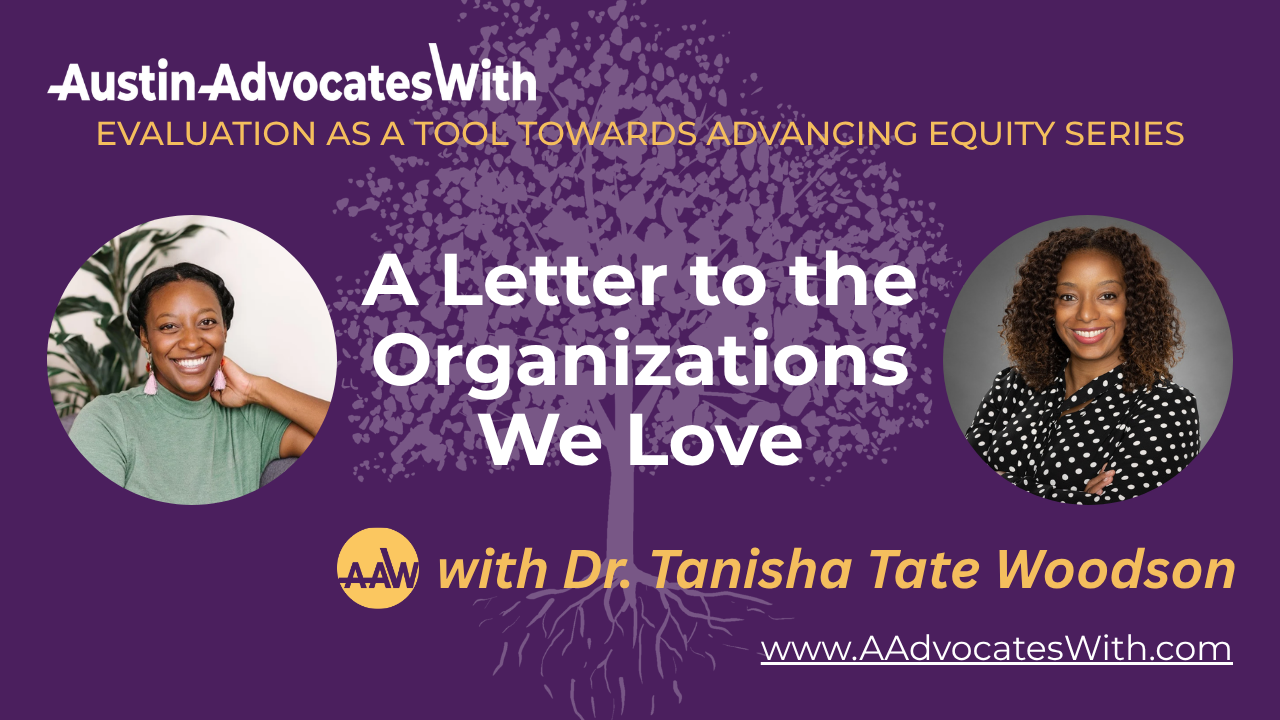
A Practitioner's View
FEATURED VOICE — DR. TANISHA TATE WOODSON, PHD
I wanted to ground what I'm asking of organizations in the perspective of someone who evaluates this kind of infrastructure for a living.
Dr. Tanisha Tate Woodson, Principal Evaluator & Strategist at Woodson Insights, has spent years watching how organizational practices, shaped by different contexts, values, and constraints, can still end up creating real barriers for leaders of color, even when no harm was intended. She also designed and led the curriculum for the fifth cohort of LEEAD (Leaders in Equitable Evaluation and Diversity), an Expanding the Bench program building a pathway for diverse leaders in culturally responsive and equitable evaluation.
On what leaders are actually carrying
"A lot of work I do really amplifies the culture and the context — situating the person within the work we're doing. As evaluators, we hold so many hats: we're facilitators some days, activists other days, geeking out in the data in other ways. Across the board, I see people in nonprofits holding so much in. They didn't get into this world to run a business or create a data infrastructure. They got into this because they were passionate about an issue, trying to address what the systems around them have not."
On what she's learned about her own capacity
"I am learning it, and unlearning certain things, and relearning how to take care of myself. If you were raised with a scarcity mindset around money, like I was, you start to see that creep into how you approach work — we gotta say yes, we gotta say yes. What therapy has helped me relearn is that it's okay to not give an immediate yes, to really sit with something for a moment. And sometimes it needs to be a no. Opportunities will come around."
On the unconscious, systemic weight of devotion
"During COVID, there was such an onus on individuals to take on the identity of being aware of injustice and wanting to advocate for change. We saw Black leaders, especially Black women, stepping up to carry the charge — and even though for a lot of us this was our life's passion, it came with a lot of burden. Now that we've seen the mass exodus of a lot of those roles, I don't believe much transformation happened inside those organizations, because I don't think they were really ready to change. Systems are resilient. It's still driving toward artificial deadlines, pseudo timelines that aren't rooted in anything real — and it's leading to people feeling like they have to neglect themselves for the sake of someone else's agenda."
"I don't think people who run organizations really understand the type of pressure leaders are under when they're trying to create these organizational change mechanisms — to create spaces where everybody feels seen, loved, welcome, and like they belong. On paper and on the surface, I'll hear them say, 'oh yeah, you should take time off', but then we still need this report. It's this double edge: take some time, but not too much time."
On building systems together
Reflecting on her past work with LEEAD:
"LEEAD and programs like it really faced a lot of issues this year, coming off the heels of 2025, where things were stripped and gutted. What's disheartening is there aren't a lot of spaces for people to operate within these principles, so they have to go create their own. If the system isn't going to hold it, we have to build it — but we have to build it collectively, because individual effort alone doesn't move a system. We need to create it within ourselves, so we're able to push back and keep bringing people with us. It should be systematic change, not just individualistic change. That's what's more enduring."
On choosing rest, and modeling it forward
"Rest for me looks like planning a vacation and actually committing to that time, usually it's the payment that makes it real, that makes me shut everything down. Whenever I stop and slow down and connect with people, I come back to my work with more energy and new ideas. I want to model that for my kids too, that yes, you have homework, you have practice, but you also have yourself. What do you need to do to recharge and connect with yourself? That's something I want to keep reminding myself, and the people around me."
We Show Up Because We Choose Love
Before I close, I want to come back to the heart of this letter. Individual practice matters, but it is not the fix. As Dr. Woodson put it, individual effort alone doesn't move a system. This is not a leader problem to solve with better self-care. It is a systems problem, and it belongs to the organizations holding those systems.
bell hooks wrote in Outlaw Culture (1994) that the moment we choose to love, we begin to move against domination and oppression, and toward freedom for ourselves and others. I think about that often when I think about why leaders of color find their way into this work at all.
Because we don't take on this work by accident. So many of us want to be the change we want to see, and we look for organizations whose missions align with that. We feel the weight of the issues our communities face, we understand the stakes in ways that aren't abstract, and that closeness moves us to be part of the solution.
But caring about the mission doesn't mean we don't also care about fair pay, accessibility, capacity, and sustainable process. We want the conditions to actually enjoy the work we've chosen, and to stay whole people beyond it, not defined solely by it. Too often, organizations read our mission-alignment as permission to ask for more, assuming that if the work matters enough to us, we won't mind what it costs. That assumption quietly keeps a lot of unsustainable systems running.
I know this personally. Part of what my burnout cost organizations was me. I no longer work inside one. Like my dad, I chose to build my own conditions, and I still work in relationship with organizations, just from a different seat. That seat lets me see a lot. Across the many organizations I partner with, I pay attention to who is tending to their staff well, who is resourcing them, and who is struggling to. I'm gathering those examples because I know it's possible, and I want more organizations to get there.
This letter is a loving critique, a call in rather than a call out. It isn't asking leaders to reshape themselves to fit systems that weren't built for them. It's asking organizations to build something different, and they can. It starts with seeing the fuller wealth their leaders of color carry, building real infrastructure for rest, pay equity, accessibility, and boundaries, and asking, genuinely and regularly, what it would take for this work to be sustainable, not just survivable.
The leaders doing this work are not a renewable resource, and our commitment to a mission was never permission to ask us to disappear into it. We are people, moving from love. Organizations, let’s build accordingly.
In Issue 3B, I turn the lens toward leaders themselves. Not to shift the responsibility back, but because while systems are changing, leaders still deserve language, encouragement, and strategy for protecting what's theirs to protect.
With gratitude and hope for what's possible,
Amani
Reflection Questions
Where might your organization be quietly depending on a leader's devotion to fill a gap that infrastructure could be filling? What would it look like to resource that work instead?
What extra labor might your most committed leaders be carrying that no one has named? How could you notice it, and advocate for resourcing it, without asking them to explain it to you?
Just for you: where have you seen passion or devotion treated as an unlimited resource, in a workplace, a community, or maybe in yourself? What comes up as you sit with that?