Process Evaluation as a Liberatory Practice
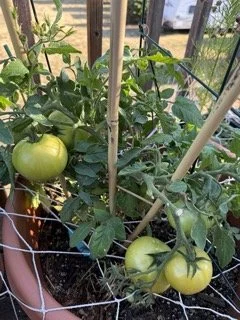
This is the second summer I’ve had the privilege of growing my own container companion garden. I planted tomatoes and cucumbers surrounded by marigolds and herbs like basil and dill whose work is quiet and essential. This set up supports good growth with pest deterrents, pollinator magnets and is beautiful enough to lift my spirits. However, I have watched myself wanting to intervene to rush my garden’s growth. To fix. To check, and check again, and ask why the green tomatoes aren’t turning yet.
This is Issue 1 of our six-part series, Evaluation as a Tool Towards Advancing Equity. In alignment with my neurodivergent brain, I strongly believe that the how is just as important as the what. So we begin this series talking about process, because it is foundational.
When Process Is the Point
In most organizational spaces, evaluation is treated as a reporting obligation, something done at the end, done to you, filed away so the funder stays satisfied. This can, reasonably so, put a bad taste in your mouth about evaluation. Process evaluation asks something different: not just did it work, but how did we work? What was the quality of our relationships, our pacing, our decision-making? Whose experience was centered, and whose was not?
When we treat evaluation as a living process rather than a compliance task, it can be transformative. It creates space for genuine inquiry, for adaptation and learning. How an organization operates is a form of communication, and it can be felt more explicitly than language in your mission or strategic plan. For example: if an organization says it values community voice but moves too fast for the community to participate, the pace is the real message. And community is the best at discerning between what you say and what you do.

Another element that primes us to tend to our processes is that the container shapes what it holds.
The infrastructure an organization builds includes your process, your culture, your internal agreements, your pace. And like the container you grow your plants in, this infrastructure shapes your organization’s capacity to reach its outcomes, develop and sustain relationships, and make meaningful impact. This matters because a rushed, hierarchical, disembodied process cannot hold relational, healing-centered outcomes. So process evaluation must matter. Because if you're not examining how you move, you may be sending a message and growing conditions you never meant to create.
The Gap Between Values and Pace
I often witness organizations that genuinely want to center community voices and share power, but whose pace is too fast and whose processes are too bureaucratic for the community to meaningfully participate, especially for community members who may already face barriers. This could look like a decision-making timeline so compressed that by the time community input is gathered, the decision has already been made. Or a process with too many steps, so that only the most resourced and persistent people can navigate it.
This is not a values problem. It is a structural one. Tema Okun names urgency as a characteristic of white supremacy culture, a pace that makes it difficult to be inclusive, think long-term, or consider consequences. This urgency lives inside even organizations most committed to dismantling it.
Tema Okun: a continued sense of urgency that makes it difficult to take time to be inclusive, encourage democratic and/or thoughtful decision-making, to think long-term, to consider consequences. White Supremacy Culture, co-authored with Kenneth Jones (dRworks, 2001)

Process evaluation holds a mirror to this gap. It asks: are we moving at the speed of trust, or the speed of the grant cycle?
When Relationship Is the Foundation and Process Can Honor It
Some of the most deeply relational organizations I've worked alongside, led by and for BIPOC communities, carry a valid skepticism around systemic processes. In their experience, process has meant bureaucracy: inflexible rules and hoops to jump through rooted in white supremacy culture, systems that create more work for staff, feel invasive, and remain inaccessible to the very community they claim to serve. In evaluation, this often lands as metrics imposed from the top down, and reports that are long, complicated, and polished, but lack nuance, prioritize numbers over stories, and don't translate back to community in meaningful ways. It is entirely understandable that many BIPOC, community-rooted organizations are not the biggest fans of the process.
But there is a kind of process that is not that. We can co-create processes that are relational by design, a guide rather than a rulebook, moving at the pace of the community it serves, reflecting organizational values that go beyond funder requirements. This is the work I love doing with organizations: when a process becomes values-centered and deeply relational, it stops being an obstacle and starts being an offering.
I think of process as a form of intentional, ongoing care; and hospitality is a great example of this. My mother loves to host: weddings, church gatherings, birthdays, and informal get-togethers. In my years as her informal assistant, I learned that how you set up the environment, how you greet people, and who you invite sends a message about the vibe and how welcomed someone truly is. As Maya Angelou said, “people will forget what you said and what you did. But they will never forget how you made them feel.” We should be thinking about that in our organizations too. We have the opportunity to bring our processes to life and care about the quality of the experience for everyone who moves through them. So what kind of welcome, vibe, and hope is your organization spreading through your how?
“It is egregious the amount of radical time we waste in bad process, the amount of community attention capital we squander. Real relationships make it harder to waste each other’s time. Real relationships are a building block of hope that can change material conditions.”
— adrienne maree brown, Holding Change (AK Press, 2021)
One consequence of the absence of quality process is unequally distributed burden, including the emotional labor people carry while trying to navigate systems without clear, equitable pathways. When an organization lacks shared agreements, documented practices, or collective ways of making decisions, someone still has to hold that knowledge. In practice, the burden falls on whoever steps up, stays late, or simply cannot afford to let things fall apart. And the people most likely to absorb that uneven weight are often those with the least institutional power, the least protection from formal role definitions, and the fewest resources (time, energy, seniority) to push back or set limits. We will return to this in Issue 3, which looks at leaders of color carrying the weight of their organizations to the point of burnout.
A liberatory process evaluation asks directly: what is the experience of the people doing this work? Do they feel ease, resource, and support? Do they experience genuine joy in it? Or are they surviving it? Staff experience is not separate from organizational effectiveness. it is organizational effectiveness.The internal climate of an organization is a leading indicator of the quality of care it can offer to the community.
“Rest is a form of resistance because it pushes back and disrupts white supremacy and capitalism. Our bodies are a site of liberation.”
— Tricia Hersey, Rest Is Resistance: A Manifesto (Little, Brown Spark, 2022)
Clear, humane processes help protect staff from the invisible tax of overextension. When agreements are shared and documented, no single person has to carry the plan alone; the weight is distributed across the organization rather than absorbed by whoever is most committed or most vulnerable. Liberatory practice means that the people working to create change, especially BIPOC and queer staff disproportionately carrying this labor, get to experience ease, resource, and enjoyment. Not as a reward for productivity, but as a condition of the work itself.
Process evaluation, then, is a strategy of intentional and ongoing care; for human capacity, for organizational sustainability, and for ensuring that what the organization holds doesn't disappear when people do. The question it invites us to ask is:"How do we build processes that hold our people well, so that no one has to carry everything alone?"
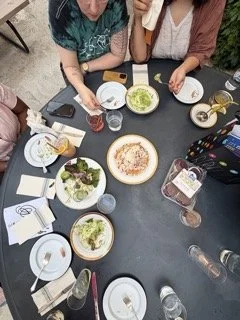
From the Kitchen to the Dining Room
If you’ve been watching The Bear on FX, you’ve been watching a live illustration of this argument. Both the challenge and the beauty, the chaos and the gained cohesion. People working together for the love of what they do and leaning on one another to each play their role with integrity. How the team feels and flows impacts how the community experiences its efforts.
Season 2 is a season about investment in people and process. Carmy and Sydney don’t just renovate the physical space, they rebuild the culture of the kitchen. Line cooks go to culinary school. Richie stages at one of Chicago’s finest restaurants and comes back transformed, not because he was corrected, but because he was developed. Marcus apprentices in Copenhagen. Everyone is invested in, everyone is tended to, this reminds us that staff development and morale is important, while being one of the least funded/supported organizational areas. In the show, The Bear, the kitchen finds its cohesive flow. And the dining room feels it. The guests who walk through the door experience something that was built long before they arrived, in the relationships, the training, the shared agreements, the care behind closed doors. The community in the dining room receives what the kitchen was willing to build for itself.
Season 3 offers the cautionary counterweight. When the pursuit of excellence overrides care for the people doing the work, when a leader’s vision becomes untethered from the team’s actual capacity and wellbeing, the kitchen that was built with such care begins to fracture. Staff become soldiers. Resentment builds behind the stove. The cohesion erodes, not because the people aren’t talented, but because the conditions stop holding them.
▶ Coming in Issue 4: Capacity is Not a Limitation, It’s a Starting Place — what does it mean to build strategy from what you actually have, not what you wish you had? Coming in Issue 4.
For now: the kitchen, like the organization, is only as strong as the conditions it creates for the people working inside it. Process is not the obstacle to great work. It is what makes great work survivable.
Reflection & Invitation
I want to name this personally:
As an external evaluator and as a Black woman, pace has become one of the most important dimensions of my practice, especially in a season where there is great social and political violence and I am experiencing personal grief and struggle. I need space to care about my work, while having room to be human, to experience shifts in my capacity as my grief comes and goes as it pleases. So the process is not just a methodology, but holds importance somatically. I love this work deeply, yet I am learning, much like my garden continues to teach me, that passion shouldn’t require overriding my own physical being.
In my efforts to unlearn white supremacy culture which prioritizes production over people, I constantly have to name that my nervous system matters too. The sense of ease and groundedness I bring into a collaboration shapes the quality of what I contribute in this co-creative work. When the rhythm is not tended to, we risk outpacing the development of trust, and that is felt in the work as well as its impact.
When I invite organizations into this deeper process, I am speaking from a place of shared experience rather than from the outside. I want to move at the pace of trust with those I work alongside. I want partnerships that align with my values and with my embodiment. Process evaluation is certainly for the communities being served, but it is also how I safeguard the integrity of my practice and ensure I can show up whole.
This is what I mean when I say process evaluation can be liberatory. It is not a framework I hold at a distance. It is something I am learning to live through praxis, season by season, in my work and in my garden.
As you read this, I invite you to sit with a moment from your own work; a meeting, a project, a collaboration.
What was the pace of that process? Whose rhythm did it move at? Who had to stretch or shrink themselves to keep up, and who set the speed?
And if your organization is one that runs on deep relationships and has kept processes at a distance:
What would it feel like to build something that protects what you’ve already created? Not a system imposed from outside, but a structure that grew from inside, that reflects your values, honors your people and ways of being, and lightens the load?
You don’t have to answer that today. Let it sit, like green tomatoes on the vine. Sometimes the most important thing is to stay present to the question, and trust that what you need will come in time.
With care and in community,
Amani | Austin Advocates With (AAW)